Saturday, January 14, 2023

PROTON SUPRIMA

 PROTON SUPRIMA 

The five-door, small hatchback Proton Suprima S, also known as the P3-22A, was created by the Malaysian automaker Proton. It was made available on August 17, 2013, and it is built on Proton's P2 platform. The Suprima S is a counterpart to the Proton Prevé saloon and was created with a stronger focus on global markets. The English term Supreme is the source of the name Suprima. Sports is represented by the S prefix. 

PRE-LAUNCH

Since 2009, the Proton P3-22A and its sibling, the Proton Prevé, also known as the Proton P3-21A, have been in development together. Local web media gave the first spy photo of a P3-22A prototype, which was taken on December 14, 2012, a lot of coverage. The prototype, despite being tightly covered, showed that the majority of the exterior panels and features, with the exception of the region behind the C-pillar, were carried over from the Prevé. Eight days later, a different prototype was seen with larger seven-spoke alloy rims than the Prevé's 16-inch ten-spoke alloy rims. Since then, other P3-22A prototypes have been seen on Malaysian highways; each one was covered in masking or camouflage tape. More spy images circulated online on July 4th and clearly displayed new features not found in the sedan model, such as front parking sensors, extra internal speakers, and a new dark blue paint colour choice. The spy photos with the greatest amount of information were taken on July 30, 2013, while the P3-22A was being used in a TVC in the middle of Kuala Lumpur. A revamped honeycomb front grille, new foglight housings, stronger LED DRLs, and a rearview camera were all clearly visible in the photographs in addition to the entirely remodelled rear and the aforementioned features. A few days later, a trailer was spotted transporting numerous P3-22A manufacturing units, indicating an impending debut in August 2013.


The Proton Suprima S's ultimate name and slogan, "Fully-loaded with built-in value," were confirmed in a spy photo taken on August 14 of a P3-22A test drive vehicle. In January 2013, Proton submitted a trademark application for Proton Suprima with the Intellectual Property Corporation of Malaysia (MyIPO). The company's future D-segment luxury saloon, the Proton Perdana Replacement Model, was once thought to go by the name Proton Suprima. About two days before its intended introduction, on August 15, 2013, the whole Proton Suprima S brochure was leaked online.

POST LAUNCH

On August 17, 2013, the Proton Suprima S was ultimately launched in Kuala Lumpur at two events: the VIP launch at the Matrade Exhibition & Convention Centre, which was supported by Tun Dr. Mahathir Mohamad, the company's founder, and the public premiere at Pavilion KL. The well-known Malaysian automotive news website, paultan.org, covered the VIP debut in an exclusive live video on YouTube.

The Prevé saloon, the Suprima S's sibling vehicle, debuted on April 16, 2012, around 16 months before. The Prevé saloon and the Suprima S share a significant portion of their body panels and parts. The Executive and Premium trims are the two available varieties of the Suprima's two trim colour options. Proton's 1.6L CamPro Turbo engine, mated to the company's ProTronic CVT—its take on a manual transmission—powers both variations. Six SRS airbags, an ABS with electronic brakeforce distribution (EBD), brake assistance (BA), traction control (TCS), and electronic stability control are standard on all Suprima models (ESC). The Proton Infotainment System, an advanced 7" LCD touchscreen GPS head unit with DVD, Bluetooth, USB, iPod & 4G WiFi compatibility, is also included as standard. The Prevé's Premium trim previously included features like steering-mounted paddle shifters, automatic headlights and wipers, climate control, cruise control, and push-start engine ignition. The Premium trim now includes exclusive kit like Anthracite-shade leather seats, two tweeter speakers, front parking sensors, a reverse camera, and brighter LED daytime running lamps (DRLs). Price ranges for the Suprima S range from RM76,338 to RM79,988. Over 835 Suprima S units were subsequently sold by Proton between the middle of August and the month of September.

SAFETY 

  • Australia / New Zealand - ANCAP -
  • United Kingdom - MIRA -
  • Malaysia - MyVAP -

After the Prevé, the Suprima S is the second Proton vehicle to receive the full 5-Star safety certification from Australia's and New Zealand's Australasian New Car Assessment Program (ANCAP). Although the Suprima has not been formally crash tested by the ANCAP, the independent, ANCAP-recognized MIRA of the United Kingdom has thoroughly examined and evaluated the vehicle. The Malaysian Domestic Market (MDM) Prevé had previously received a five-star rating from the Malaysian Vehicle Assessment Programme (MyVAP) of the Malaysian Institute of Road Safety (MIROS), however the Suprima has not yet received an official rating. However, the Suprima has curtain airbags in addition to all the other safety features that the MDM Prevé previously provided, essentially making it a safer vehicle than its sibling and earning of a five-star certification as well.

A maximum of six SRS airbags, an anti-lock braking system with electronic brakeforce distribution (EBD), brake assistance (BA), traction control (TCS), and electronic stability control have all been built into the Suprima S, just as the Prevé (ESC). The MDM Prevé Executive trim models were only available with 2 airbags without BA, TCS, or ESC at launch, whereas all Suprima units came standard with all of its engineered safety features at launch. In contrast, the MDM Prevé Premium trim was only available with a maximum of 4 airbags with all electronic safety equipment. Proton automobiles had a bad safety reputation prior to the introduction of the Suprima S and Prevé pair. In 2009, the Proton Jumbuck's ANCAP test resulted in a notoriously low one star out of a possible five. In response, Proton considerably raised safety regulations while creating the Prevé and Suprima S. The pair-specific REinforced Safety Structure (RESS) frame was created. During the manufacturing of the Prevé and Suprima, Proton uses the Hot Press Forming (HPF) method, which was invented in Germany.

The passenger compartment is strengthened with the use of twelve HPF components, improving occupant safety. As a result, the tensile strength and torsional body stiffness are enhanced by 19,000 Nm/degree. HPF is used in the manufacturing process to reduce weight, which leads to better handling, performance, and fuel economy. In South East Asia, Proton is the only Original Equipment Manufacturer (OEM) who uses hot press forming in their production methods.


Sunday, January 8, 2023

PROTON EXORA


A vehicle made by Malaysian automaker Proton is called the Exora. When it was released on April 15, 2009, it was Malaysia's first locally developed compact multi-purpose vehicle (MPV) in the C-segment. The Exora was the first Proton to employ the P2 platform and the first Proton to use the CamPro CFE turbocharged engine and CVT in its facelift iteration, which made its debut on December 15, 2011.

HISTORY OF PROTON EXORA

The 1990s saw the creation of the first Proton MPV drawings. All of Proton's models during this time were either saloons or hatchbacks. The Juara Mini-MPV, a rebadged Mitsubishi Town Box Wide, was introduced by Proton in 2001 as an experiment with larger automobiles. However, due to weak sales and criticism of its unorthodox kei car design, it was cancelled in 2004.

Later, in the middle of 2006, the Proton MPV project was resurrected under the direction of Syed Zainal Abidin, the former company managing director. Initially thought to be based on a Mitsubishi or Volkswagen platform, the car was to be tailored to Malaysian preferences and expectations. However, Proton later revealed that it will be constructed from the ground up on an entirely new platform. The Proton P2 platform was created as a result, internally by Proton with assistance from LG CNS. The Proton MPV's scheduled introduction for early 2009 was formally revealed on February 11th, 2008.

On May 27, 2008, Malaysian national television broadcast sketches of the MPV that gave a sneak peek at some of its impending features. It was previously assumed based on the sketches that the Proton MPV was related to a comparable MPV made by Chery in China, but it was later established that there was no such relationship. However, given the long-standing partnership between Proton and Mitsubishi, it was obvious that a number of design cues were borrowed from the Mitsubishi Grandis. On October 24, 2008, Proton submitted a patent application to the United Kingdom Intellectual Property Office (IPO) for the forthcoming MPV, and on November 4, 2008, the application was accepted.

On February 17, 2009, Proton Exora's official name and slogan, Keriangan Keluarga (English: Family Fun), were revealed. The grand prize winner, Norsholihan Binti Abdul Eanich, selected "Exora," a name for the Proton MPV that was based on the Ixora flower, from among 251,763 submissions. Production of the Exora began in March 2009 at Proton's Shah Alam factory after an 18-month development process.

The Proton Exora, the first MPV made in Malaysia, was formally launched on April 15, 2009. At first, it was available in two trim levels, the M-Line and H-Line, respectively. Both variations were equipped with a four-speed automatic transmission and a 1.6 litre CamPro CPS engine. On July 7, 2009, the Exora M-Line MT was unveiled and became the first Exora version to be offered with a five-speed manual transmission. On June 22, 2009, the Exora was observed being tested in a basic configuration. It eventually took the form of the Exora B-Line trim, which was introduced on November 19, 2009, four days before the Perodua Alza went on sale. The version has fewer safety features and is only offered with a manual transmission.

SAFETY  

After 32 Exoras were involved in crashes at the Spanish Applus+ IDIADA crash testing facility, the Exora received an equivalent 4-star EuroNCAP rating. Additionally, Malaysia's own MyVAP evaluation programme gave the Exora a 4-star rating. All Exora models received the same four-star ANCAP safety rating. The MPV received a score of 26.37 out of a possible 37 points and has dual frontal and side airbags with thorax and head protection for front occupants. The Exora received a 10.55 out of 16 point rating in the offset crash test, with acceptable driver leg and chest protection.

The driver chest protection was rated as adequate in the side impact crash test, where it received 14.82 out of 16 possible points. The Exora result, which was based on testing completed in July 2013, represented how well it performed in the 40% frontal offset test, where there was a high risk of the driver's legs suffering significant injuries. ANCAP reported that while side impact performance was good, overall pedestrian test results were dismal. The use of high tensile steel for the body cage, which offers improved stability and increased impact absorption during a collision, is one of the essential elements that enabled these ratings. Additionally, side impact bars are put in place to strengthen door frames and deflect side collisions.

SPECIFICATION  

Throughout the Proton Exora production, two engines have been available: A 1.6L naturally aspirated CPS engine and a 1.6L turbocharged CFE engine.

Engine

CamPro CPS

CamPro CFE

Format

14 DOHC 16V

14 DOHC 16V

Compressions ratio

8:9:1

8:9:1

Total displacement (CC)

1597

1561

Bore x Stroke (mm x mm)

76.0 X 88.0

76.0 X 86.0

Maximum output HP (KW)/Rpm)

125(93) / 6500

138(103) / 5000

Maximum torque (Nm/RPM)

150/4500

205/2000 - 4000

 suspension

The MacPherson strut and coil spring are used on the front of the Proton Exora, and the torsion beam and coil spring are used on the rear.

steering 

The Proton Exora uses a rack & pinion hydraulic power steering system and has a turning radius of 5.4 meters.


Sunday, January 1, 2023

PROTON INSPIRA

History

    Proton, a Malaysian automaker, introduced the four-door Proton Inspira in November 2010 as their first compact saloon. As a result of a partnership between Mitsubishi Motors and Proton, it was only offered in Malaysia as a rebadged ninth-generation Mitsubishi Lancer. The Proton Inspira, which replaced the Proton Waja, complements the locally produced Proton Prevé in the Malaysian market. The word "Inspira," which signifies inspiration in English, is derived from the Malay word Inspirasi.

    An agreement between Proton and Mitsubishi Motors for the transfer of technology was renewed. This arrangement was crucial to Proton's founding in the middle of the 1980s. As a fair form of technology sharing, Mitsubishi would receive the Exora to rebrand in Japan under them.

    After dealers started taking reservations for the Inspira, 1,100 orders were placed within the first 10 days. The Mitsubishi is imported as a CBU from Japan, whereas the Inspira is locally produced and costs substantially less than the Lancer in Malaysia. In addition to significantly cheaper import taxes, Proton is entitled to financial incentives from the government because it invested in locally manufacturing the model, which enables it to lower pricing.

    Proton has drawn criticism from some groups, though, for resuming the practise of rebadging vehicles. When the Proton Waja was introduced in 2000, Proton had gotten away from this practise. After then, Proton continued to create 6 additional models on its own. According to reports, Datuk Syed Zainal Abidin Syed Mohamed Tahir, the managing director of Proton Group, claimed that developing a new car from scratch would cost Proton up to RM700 million (USD230 million), but that doing so through a partnership with Mitsubishi Motors would only cost half as much. This makes it possible to promote the Proton Inspira for less money.


    Mitsubishi granted Proton permission to rebadge the Lancer provided that no essential characteristics were altered. The majority of the Inspira's parts are thus interchangeable with those of the Lancer, including the powertrain, which is imported in completely completed form from Mitsubishi Motors Japan. While Proton also sought to improve the Inspira's build quality, the Inspira did come with modified suspension to enhance driving dynamics and handling. Mitsubishi management praised the improvements made to the vehicle after inspecting the Inspira in Shah Alam.


Time Line 

    The Proton Inspira made its premiere on November 10, 2010, in two variants: the 1.8E (Executive, manual or CVT gearbox) and 2.0P (Premium, CVT only), both available in a choice of four colours: Plum Red, Solid White, Genetic Silver, and Tranquility Black. Dual SRS airbags, a leather-wrapped steering wheel, front pre-tensioner seatbelts, ABS with EBD, an immobiliser, an alarm system, a central locking system, ISOFIX child seat anchors, solar and security tinted glass, steering wheel-mounted audio controls, a trunk lid remote release, front fog lights, a welcome light system, a driver's side anti-trap/auto up/down power window, a height-adjustable driver.

    Cruise control, column-mounted shift paddles, dark brown wood trim (as opposed to matte silver trim on the 1.8E), automatic climate control, automatic headlamps, automatic rain sensors, body kits, a trunk lip spoiler, Nappa leather upholstery on the seats and door trims, a leather-wrapped gear knob, and a GPS navigation system were added with the 2.0P. The Proton Inspira R3 restricted edition of the Proton Inspira was introduced in November 2011. With modifications like the inclusion of R3 body kits, an R3 trunk lip spoiler, and R3 18" alloy wheels, it was based on the 1.8E model of the basic Inspira. But this model was only offered with a manual transmission.

    The Proton Inspira R3 restricted edition of the Proton Inspira was introduced in November 2011. With modifications like the inclusion of R3 body kits, an R3 trunk lip spoiler, and R3 18" alloy wheels, it was based on the 1.8E model of the basic Inspira. But this model was only offered with a manual transmission.

    The Proton Inspira 2.0 Executive was introduced in June 2012 to replace the 1.8E CVT and was offered in 4 colours: Elegant Brown, Tranquility Black, Genetic Silver, and Solid White. Newly designed alloy wheels measuring 16" are on it. The 2.0 Executive version differs from the 2.0 Premium variant in that it has fabric upholstery on the seats and door trimmings as well as matte silver trim as opposed to the 2.0P's dark brown wood trim. In addition, this model was devoid of the rear spoiler, body modifications, and windscreen wipers that could automatically regulate their pace. The Proton Inspira 2.0 Premium was revised in July 2012 with 17" alloy wheels and a new head unit with a touch screen interface. One new colour was introduced for the Inspira with the release of the revised 2.0P version: Virginia Grey (2.0P only). In January 2014, the Proton Inspira Super Premium was launched with only one color available: Solid White. Moving on from the 2.0P, it adds on 18" R3 alloy wheels, R3 sport springs, R3 “Blood Stripe Stickers" and R3 body kits consisting of a front splitter, side skirts, a rear apron and a boot spoiler. The R3 add-ons were rather similar to those offered in the limited edition Proton Inspira R3. Like the 2.0P, it was only available in one transmission option: CVT. 

    Proton Inspira models produced between September 2010 and May 2011 were subject to a recall in February 2015 due to issues with the drive belt pulley (V-ribbed belt). The Proton Inspira's manufacturing was formally stopped in April 2015. The Proton Inspira was once more subject to a recall in May 2016, this time over a problem with a faulty right turn indicator switch for cars manufactured between 2010 and 2014.


Monday, December 26, 2022

Proton Preve

PROTON PREVE / SUPRIMA S - Wiperfix 

HISTORY OF PROTON PREVE   

    Beginning in 1985, Proton produced automobiles that were badge-engineered to look like Mitsubishis. Because of the better engineering and dependability of the Mitsubishi automobiles on which they were based, Proton cars were able to sell in large numbers. However, when the twenty-first century ushered in, Proton advanced by releasing models that were domestically created, such the Proton Waja and Proton GEN2. Unfortunately, these Protons of the next generation received a lot of flak for their shoddy engineering. As a result, Proton's market share in Malaysia rapidly decreased in the early 2000s, reaching a record low in 2007.In response, work on the Proton Preve (code-named P3-21A) began in 2009 under the direction of Syed Zainal Abidin, who was then the company's managing director. Dr. Wolfgang Karl Epple, a former vice president of quality management research and development at BMW, was also appointed director of quality for Proton in the same year. Later on, he received a promotion to Senior Director of Group Operations, where he helped to create the P3-21A project.

    The Italdesign Giugiaro-created Proton Tuah concept car was displayed at the 2010 Kuala Lumpur International Motor Show (KLIMS). It gave a peek of the different functionality and design facets of the future Proton P3-21A. A year later, the P3-development 21A's was finished, and production began at Proton's Tanjung Malim plant. In an effort to limit capital outflow, the business asserted that 94% of the parts for the car were sourced domestically. Only a few days prior to launch, the Proton Prevé's official name was made public.

    The Proton Prevé was officially revealed on April 16, 2012, at Seri Kembangan by Najib Razak, a former Malaysian prime minister. The Executive MT, Executive CVT, and Premium CVT are the three trim variations available at launch. Proton's 1.6L CamPro IAFM+ engine powers both Executive trim models. The Executive CVT has a CVT whereas the Executive MT is paired with a five-speed manual transmission. The improved 1.6L turbocharged CamPro CFE engine is available with the Premium model and is paired with a CVT, commonly known as ProTronic, which is Proton's take on a manual transmission. The Premium trim adds two more airbags, brake assist, traction control, and electronic stability control (ESC) to the Executive's dual SRS airbags, anti-lock braking system (ABS), and electronic brakeforce distribution (EBD), all of which are safety-related equipment.

    The Premium edition also comes with specialised equipment including push-start engine ignition, steering-mounted paddle shifters, automatic headlights and wipers, cruise control, climate control, and an integrated touchscreen GPS head unit with Bluetooth, USB, and iPod compatibility. All Proton Prevés come with a Smart Information Display system (SiD), which shows data such as average fuel use, battery health, and remaining range before running out of fuel. In-car WiFi is another basic feature made possible by a partnership between Proton and Malaysian ISP, Yes 4G. Price range for the Prevé is RM59,540 to RM72,990. It received over 11,000 bookings within two months of its official launch and became the 7th-best-selling car in Malaysia for the month of May 2012, topping all rivals in its category.

DESIGN  


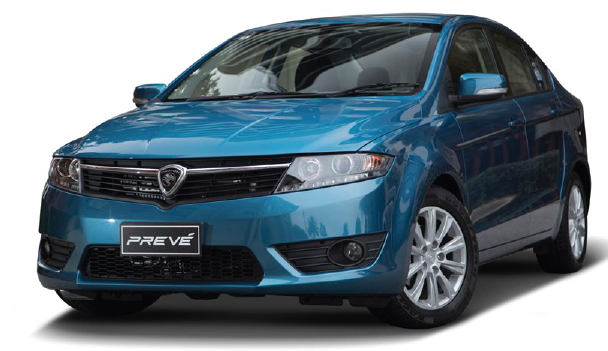
    With the Prevé, Proton aimed to establish a new characteristic façade. Proton Wings, a single design feature that unites the headlights, Proton symbol, and air-intake grille, is the outcome. It gives the vehicle the unmistakable appearance of a bird ascending. The Prevé is the first automobile built in Malaysia to have LED position lighting installed from the manufacturer. To increase fuel efficiency, the car's bodywork was designed to have a lower drag coefficient. [56] Italdesign Giugiaro S.P.A., based in Italy, and Proton worked together to style and replicate the Prevé. The 2010 Proton Tuah concept car's styling is also the work of Italdesign. Additionally, as part of the nearly one-year-long partnership with Italdesign, Azlan Othman, Proton's Head of Styling, was sent to Turin.

     Dr. Wolfgang Karl Epple, then Senior Director Operations for Proton, said that a global team of professionals from South Korea, Malaysia, Italy, France, and Germany worked together to create the Prevé. A number of the car's components are also imported from countries including Japan, South Korea, Australia, and Europe. "You obtain something that is global if you incorporate global ingredients in the components, people, processes, styling, and packaging," Epple said. However, in an effort to decrease capital outflow, Proton later asserted that 94% of the Prevé's components are acquired locally. The Prevé is also one of the largest C-segment vehicles available in Malaysia, a market that has historically been dominated by Japanese and Korean vehicles.

SAFETY 

    The Australasian New Car Assessment Program (ANCAP) of Australia and New Zealand awarded the Prevé the complete 5-Star safety certification, making it the first Proton vehicle and, in some ways, the first vehicle manufactured in Malaysia. Additionally, the Malaysian Institute of Road Safety's Malaysian Vehicle Assessment Programme (MyVAP) awarded it a 5-Star grade (MIROS).


    Proton automobiles had a bad safety record prior to the release of the Prevé and Suprima S. In 2009, the Proton Jumbuck's ANCAP test resulted in a notoriously low one star out of a possible five. During the Prevé's development, Proton responded by dramatically improving safety standards. For the new car, a reinforced safety structure (RESS) frame was created specifically. When making the frame, Proton uses a technique called hot press forming (HPF), which was invented in Germany.

    The Proton Prevé has been designed to accommodate up to six SRS airbags, an electronic brakeforce distribution (EBD) anti-lock braking system, brake assist (BA), traction control (TCS), and electronic stability control (ESC). When the Prevé made its debut in Malaysia in April 2012, only a maximum of four airbags were available. Only until the Prevé was introduced in Australia in October 2012 was the maximum of six airbags available. On October 18, 2013, Proton debuted the Prevé LE in its home country, giving the exact same safety features as the Prevé versions sold in Australia. The Prevé line was revised the following month by Proton with all of its engineered safety features included as standard equipment, standardising the Prevé for the Malaysian market as a 5-Star ANCAP-rated model.

    During the Prevé's development, Proton also tested the vehicle in a variety of weather and road conditions, including ice and snow in Sweden and sweltering heat in Spain. MacPherson struts make up the front suspension system, while a multi-link with a stabilising bar makes up the rear suspension system. Lotus, a British division of Proton, adjusted the Prevé's suspension for enhanced ride and handling characteristics. For added grip, the setup was created specifically for the 205/55 GT Radial Champiro Bax 2 tyres mounted on the vehicle. All Proton Prevés are equipped with 16-inch alloy rims and front and rear 15-inch disc brakes. Beginning in January 2014, Proton prioritised safety as one of their key USPs and aggressively promoted their accomplishments with the Prevé and Suprima S. All new Protons introduced beginning in 2014 will have a 5-Star ANCAP certification and significant safety equipment, the firm has claimed.

POWERTRAIN

    There are two petrol engines available for the Proton Prevé: the CamPro IAFM+ and CamPro CFE. Intake Air Fuel Module Plus is referred to as IAFM+, while Charged Fuel Efficiency is referred to as CFE. Proton and Lotus both designed the engines in-house. The 1.6L CamPro IAFM+ I4 engine has a maximum output of 150 Nm of torque at 4,000 rpm and 107 horsepower (80 kW) at 5,750 rpm. It can be connected to either a Punch Powertrain VT2 CVT or a five-speed Getrag manual transmission. The Proton Saga FLX SE also makes use of this CamPro IAFM+.

    A low-pressure intercooled turbocharger is a feature of the improved 1.6L CamPro CFE I4 engine that produces 138 horsepower (103 kW) at 5,000 rpm and 205 Nm of torque between 2,000 and 4,000 rpm. The only transmission available for this engine is a Punch Powertrain VT3 CVT, also known as ProTronic, which is Proton's take on a manual transmission. The 2.0-liter normally aspirated engine is said to be equivalent to the turbocharged 1.6-liter CamPro CFE by Proton. The CamPro CFE was created to meet Euro V emission requirements, and it uses 6.6 litres of fuel every 100 km at a speed of 90 km/h. A brand-new 2.0-liter turbocharged engine is currently being created by Proton for the Prevé and Suprima S pair. Also being developed is a six-speed manual transmission option.


Saturday, December 17, 2022

SAGA FLX 2008 - 2016

 PROTON SAGA FLX (2008 - 2016)

    Launched on January 18, 2008, the second generation Proton Saga is a 4-door subcompact sedan made by the Malaysian automaker Proton. It took over from the original Proton Saga as the company's "flagship" vehicle. The Proton Savvy platform, which was expanded and improved by Proton with technological assistance from Lotus Cars and LG CNS, serves as the foundation for the second-generation Proton Saga. On November 30, 2010, Proton introduced the Proton Saga FL, a newly updated model. Another enhanced variant, the Proton Saga FLX, was introduced eight months later.

    The saga seed (Adenanthera pavonina), which is widely available in Malaysia, inspired the name of this vehicle. Ismail Jaafar, the winner of the contest to name the country's car, came up with the moniker. Another well-known national emblem of Malaysia is the Proton Saga.

Keluaran Pertama (2008 - 2010)

    On January 18, 2008, the eagerly awaited second-generation Proton Saga was introduced. The first generation Proton Saga, which had a production life of 23 years and was the longest-lasting Proton vehicle to date, had previously been the company's most popular model. In contrast to its predecessors, this second generation Saga is an original design.

    The N-Line, B-Line, and M-Line models were released, with costs ranging from RM31,498 to RM39,998. A 1.3 litre CamPro IAFM engine powers each variation. The Proton Saga RED concept model was also on exhibit at the launch event. With over 23,000 orders placed for the new Saga in less than two weeks since its premiere, Proton has seen success with its sales of the vehicle. Furthermore, from 2008 to 2010, it took the place of the previous Iswara Saga as the preferred option among Malaysian cab drivers. This taxi model has a 1.6-liter 110-bhp CamPro engine and has been adapted to run on natural gas.

    The Proton Saga 1.6 B-Line was introduced in June 2009. It uses the same engine as the Saga taxi type but is devoid of a number of amenities, including a driver's airbag. The Proton Saga SE was unveiled one month later. It is marketed as a premium variant with only 2 colour options and a distinctive body kit, along with the CamPro 1.3 engine that is also offered in other models, and is priced between RM43,000 and RM45,500. The emission-free Saga EV Concept was on display by Proton on July 16, 2009, at Universiti Putra Malaysia, Serdang. It has a maximum range of 109 kilometres (68 miles), is powered by a 125kW (168hp) DC motor, and can be charged using a standard household electrical socket.

   Proton released the S16 in the Australian market on Christmas Eve 2009. The Saga was given the S16 moniker in Australia by Proton without any justification given in writing. In any case, the S16 is identical to the Malaysian model but comes with the more recent 1.6 110cc CamPro engine. The cheapest new car on the Australian market at the time, it was sold for AUD$11,990. The Chery J1, a Chinese-made vehicle, currently holds the record. Rachael Finch, the 2009 Proton Australia official ambassador, supported the S16's launch. Finch is the reigning Miss Universe Australia. 

    A limited edition version of the Proton Saga 25th Anniversary Edition was introduced in July 2010. It is priced at RM54,500 and includes leather upholstery, two airbags, four power windows, alloy rims, and a unique paint job. In keeping with Proton's milestone in the history of the automobile, just 25 units were made.


Keluaran Kedua (2010 - 2011)

    At the 2010 Thailand International Motor Expo, Proton unveiled a mid-life facelift variant of the Proton Saga on November 30, 2010. The Proton Saga FL, where "FL" refers for facelift, was the name given to it. The front and back bumpers, grille, rims, headlights, and taillights of the Saga FL were all changed. Utilizing LED technology, side turn signals are linked with side mirrors and brake lights. The Saga FL's interior features dual airbags, a Clarion audio system with USB and AUX ports, power windows for all four doors, and audio controls on the steering wheel. Saga FL's technological requirements are largely the same as those of Saga. The Saga R3 Concept was also displayed during the Saga FL debut in Thailand.

    The Proton Race, Rally, Research (R3) division created it, and it had a sporty body package, unusual rims, and a unique paint job. Unknown are its technical specs. The Proton Kasturi Concept debuted a few days later at the 2010 Kuala Lumpur International Motor Show. Proton Design developed the Saga FL-based Kasturi, and many of its features were included into a number of later models.

    Two weeks after Saga FL's premiere in Thailand, it was introduced in Malaysia. For the Malaysian market, it is offered in two variations: Standard and Executive. Both variations are offered with 5-speed manual and 4-speed automatic gearboxes. Four power windows are included as standard on every Proton Saga FL, which is a very useful feature. Then, in May 2011, the Proton Saga FL 1.6 Executive, a more potent version, was introduced. It has a 110 kk CamPro IAFM 1.6 engine, as the name would imply, and only comes with a 4-speed automated transmission option. To distinguish itself, the Saga FL 1.6 has body decals and unit alloy rims.

Keluaran Ketiga (2011 - 2016)

    Proton introduced the Saga FLX, code-named P2-11C, eight months after the Saga FL was first introduced. "Extra" is what the extra "X" stands for. The FLX is offered in Executive and Standard trim lines, just like earlier versions. The upgraded CamPro IAFM+ engine is included in both models, and it can be combined with a manual or CVT transmission.

    The Belgian-made Punch Powertrain CVT offers improved fuel efficiency than the previous 4-speed automatic transmission while also producing smooth acceleration without any jerks in the shifting. In addition, a more recent Getrag 5-speed manual gearbox was installed in place of the outdated Aichi Kikai 5-speed transmission. The Saga FLX now has two airbags and an anti-lock braking system (ABS) with electronic brake force distribution for further security (EBD). However, the Executive edition, which is more expensive, is the only one that offers such features. New settings for the suspension system that better balance ride comfort and handling ability include firmer springs, thicker front anti-roll bars, and new shock absorbers. The Saga FLX is offered in a new colour choice called Perang Elegan and is priced competitively at RM38,370 and RM45,220. The Saga FLX's exterior is identical to that of the Saga FL.

    The Proton Saga FLX SE debuted on November 30, 2011. It is propelled by a CVT with a 1.6-liter, 108-kk CamPro IAFM+ engine. Along with ABS with EBD, driver and passenger airbags are included as standard. The FLX SE has a sportier and more aggressive appearance thanks to a blue body package, blacked-out taillights, and 15-inch alloy wheels. The inside also has crimson stitching and leather trim. It is only available in Solid White and Flame Red, and its presumptive price is RM49,470, or around RM6,500 less than the Perodua MyVi SE 1.5 automatic, which is its closest rival.

    In June 2012, the Saga FLX made its debut on the Australian market under the name S16 FLX. It replaces the previous S16 in the model lineup of Proton Australia. Both the GX and GXR editions of the S16 FLX offer manual and CVT transmission options. All S16 FLX models come standard with dual airbags, ABS, and EBD, and Solid Red is a new colour. The cost ranges from AUD13,990 to AUD16,990.


PROTON SUPRIMA

 PROTON SUPRIMA  The five-door, small hatchback Proton Suprima S, also known as the P3-22A, was created by the Malaysian automaker Proton. I...