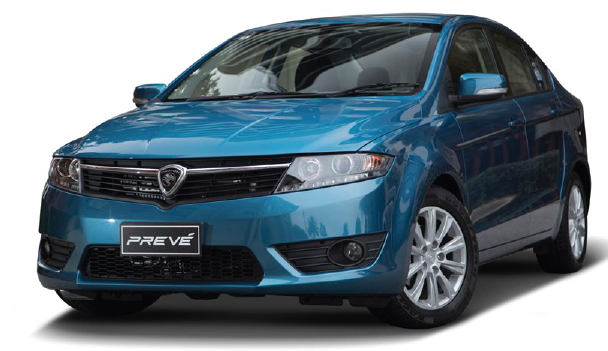
HISTORY OF PROTON PREVE
Beginning in 1985, Proton produced automobiles that were badge-engineered to look like Mitsubishis. Because of the better engineering and dependability of the Mitsubishi automobiles on which they were based, Proton cars were able to sell in large numbers. However, when the twenty-first century ushered in, Proton advanced by releasing models that were domestically created, such the Proton Waja and Proton GEN2. Unfortunately, these Protons of the next generation received a lot of flak for their shoddy engineering. As a result, Proton's market share in Malaysia rapidly decreased in the early 2000s, reaching a record low in 2007.In response, work on the Proton Preve (code-named P3-21A) began in 2009 under the direction of Syed Zainal Abidin, who was then the company's managing director. Dr. Wolfgang Karl Epple, a former vice president of quality management research and development at BMW, was also appointed director of quality for Proton in the same year. Later on, he received a promotion to Senior Director of Group Operations, where he helped to create the P3-21A project.
The Italdesign Giugiaro-created Proton Tuah concept car was displayed at the 2010 Kuala Lumpur International Motor Show (KLIMS). It gave a peek of the different functionality and design facets of the future Proton P3-21A. A year later, the P3-development 21A's was finished, and production began at Proton's Tanjung Malim plant. In an effort to limit capital outflow, the business asserted that 94% of the parts for the car were sourced domestically. Only a few days prior to launch, the Proton Prevé's official name was made public.
.jpg)
The Proton Prevé was officially revealed on April 16, 2012, at Seri Kembangan by Najib Razak, a former Malaysian prime minister. The Executive MT, Executive CVT, and Premium CVT are the three trim variations available at launch. Proton's 1.6L CamPro IAFM+ engine powers both Executive trim models. The Executive CVT has a CVT whereas the Executive MT is paired with a five-speed manual transmission. The improved 1.6L turbocharged CamPro CFE engine is available with the Premium model and is paired with a CVT, commonly known as ProTronic, which is Proton's take on a manual transmission. The Premium trim adds two more airbags, brake assist, traction control, and electronic stability control (ESC) to the Executive's dual SRS airbags, anti-lock braking system (ABS), and electronic brakeforce distribution (EBD), all of which are safety-related equipment.
The Premium edition also comes with specialised equipment including push-start engine ignition, steering-mounted paddle shifters, automatic headlights and wipers, cruise control, climate control, and an integrated touchscreen GPS head unit with Bluetooth, USB, and iPod compatibility. All Proton Prevés come with a Smart Information Display system (SiD), which shows data such as average fuel use, battery health, and remaining range before running out of fuel. In-car WiFi is another basic feature made possible by a partnership between Proton and Malaysian ISP, Yes 4G. Price range for the Prevé is RM59,540 to RM72,990. It received over 11,000 bookings within two months of its official launch and became the 7th-best-selling car in Malaysia for the month of May 2012, topping all rivals in its category.
DESIGN

With the Prevé, Proton aimed to establish a new characteristic façade. Proton Wings, a single design feature that unites the headlights, Proton symbol, and air-intake grille, is the outcome. It gives the vehicle the unmistakable appearance of a bird ascending. The Prevé is the first automobile built in Malaysia to have LED position lighting installed from the manufacturer. To increase fuel efficiency, the car's bodywork was designed to have a lower drag coefficient. [56] Italdesign Giugiaro S.P.A., based in Italy, and Proton worked together to style and replicate the Prevé. The 2010 Proton Tuah concept car's styling is also the work of Italdesign. Additionally, as part of the nearly one-year-long partnership with Italdesign, Azlan Othman, Proton's Head of Styling, was sent to Turin.
Dr. Wolfgang Karl Epple, then Senior Director Operations for Proton, said that a global team of professionals from South Korea, Malaysia, Italy, France, and Germany worked together to create the Prevé. A number of the car's components are also imported from countries including Japan, South Korea, Australia, and Europe. "You obtain something that is global if you incorporate global ingredients in the components, people, processes, styling, and packaging," Epple said. However, in an effort to decrease capital outflow, Proton later asserted that 94% of the Prevé's components are acquired locally. The Prevé is also one of the largest C-segment vehicles available in Malaysia, a market that has historically been dominated by Japanese and Korean vehicles.
SAFETY
The Australasian New Car Assessment Program (ANCAP) of Australia and New Zealand awarded the Prevé the complete 5-Star safety certification, making it the first Proton vehicle and, in some ways, the first vehicle manufactured in Malaysia. Additionally, the Malaysian Institute of Road Safety's Malaysian Vehicle Assessment Programme (MyVAP) awarded it a 5-Star grade (MIROS).
_(03).jpg)
Proton automobiles had a bad safety record prior to the release of the Prevé and Suprima S. In 2009, the Proton Jumbuck's ANCAP test resulted in a notoriously low one star out of a possible five. During the Prevé's development, Proton responded by dramatically improving safety standards. For the new car, a reinforced safety structure (RESS) frame was created specifically. When making the frame, Proton uses a technique called hot press forming (HPF), which was invented in Germany.
_(05).jpg)
During the Prevé's development, Proton also tested the vehicle in a variety of weather and road conditions, including ice and snow in Sweden and sweltering heat in Spain. MacPherson struts make up the front suspension system, while a multi-link with a stabilising bar makes up the rear suspension system. Lotus, a British division of Proton, adjusted the Prevé's suspension for enhanced ride and handling characteristics. For added grip, the setup was created specifically for the 205/55 GT Radial Champiro Bax 2 tyres mounted on the vehicle. All Proton Prevés are equipped with 16-inch alloy rims and front and rear 15-inch disc brakes. Beginning in January 2014, Proton prioritised safety as one of their key USPs and aggressively promoted their accomplishments with the Prevé and Suprima S. All new Protons introduced beginning in 2014 will have a 5-Star ANCAP certification and significant safety equipment, the firm has claimed.
POWERTRAIN
There are two petrol engines available for the Proton Prevé: the CamPro IAFM+ and CamPro CFE. Intake Air Fuel Module Plus is referred to as IAFM+, while Charged Fuel Efficiency is referred to as CFE. Proton and Lotus both designed the engines in-house. The 1.6L CamPro IAFM+ I4 engine has a maximum output of 150 Nm of torque at 4,000 rpm and 107 horsepower (80 kW) at 5,750 rpm. It can be connected to either a Punch Powertrain VT2 CVT or a five-speed Getrag manual transmission. The Proton Saga FLX SE also makes use of this CamPro IAFM+.
A low-pressure intercooled turbocharger is a feature of the improved 1.6L CamPro CFE I4 engine that produces 138 horsepower (103 kW) at 5,000 rpm and 205 Nm of torque between 2,000 and 4,000 rpm. The only transmission available for this engine is a Punch Powertrain VT3 CVT, also known as ProTronic, which is Proton's take on a manual transmission. The 2.0-liter normally aspirated engine is said to be equivalent to the turbocharged 1.6-liter CamPro CFE by Proton. The CamPro CFE was created to meet Euro V emission requirements, and it uses 6.6 litres of fuel every 100 km at a speed of 90 km/h. A brand-new 2.0-liter turbocharged engine is currently being created by Proton for the Prevé and Suprima S pair. Also being developed is a six-speed manual transmission option.


